

It was a long time ago -something like 15 years- when I first heard about Ruby and its powerful extension, Ruby on Rails. At that time I was too busy and deeply immersed in my work to give it more attention than reading a few enthusiastic articles written by a cool guy spreading the word. That was the extent of my contact with the technology. Until now.
A Gem is Born
First things first, Ruby was born in 1995 with the first public release v0.95 announced by its creator Yukihiro Matsumoto, “Matz” for friends. Matz wanted to create a language that brought developers joy and productivity, incorporating familiar features from Perl, Python, and Smalltalk -resulting in a strongly object-oriented scripting language of his own.
Not long after, Rails arrived to make Ruby truly shine. From the capable hands of David Heinemeier Hansson during the summer of 2004, with the first stable version v1.0 released on December of 2005. In simple words, Rails is a full-stack web application framework built on Ruby. The main goal was to accelerate the development through a kind of pre-built toolkit for creating web applications much like modern house construction, using pre-made walls and doors, instead of cutting and nailing every tiny piece.
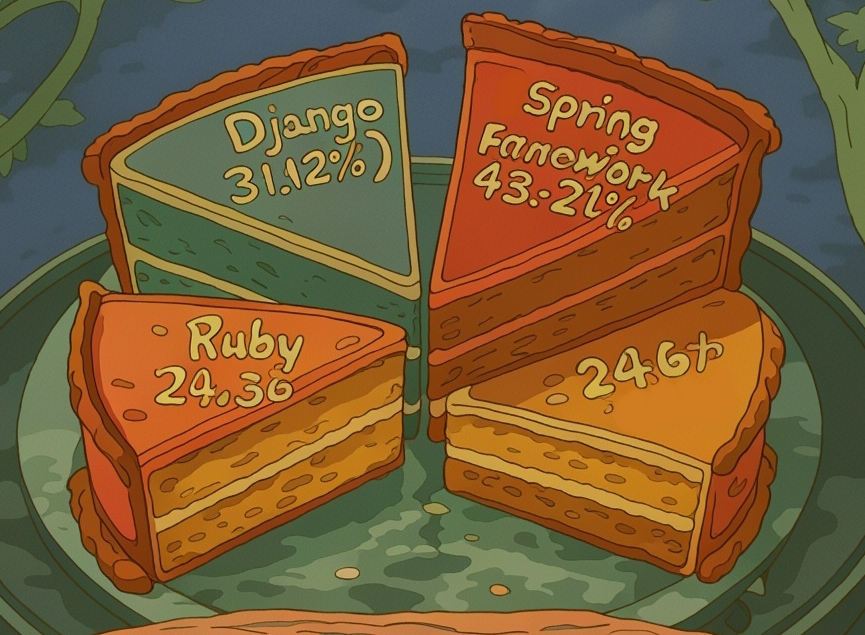
After more than 20 years of a happy marriage, Ruby on Rails holds the second-largest slice of the market share in the web framework category. With 24.48% of the market, it’s slightly behind Django (31.12%), and just ahead of the Java-based Spring Framework at 19.82%.
While it’s possible to build desktop and mobile applications, Ruby on Rails is primarily designed for -and truly excels at- web development. Ruby on Rails rules on web applications where “convention over configuration” is the motto. Being an opinionated framework, it enforces a specific set of conventions, practices, and workflows as the right way to build the given application.
Don’t repeat yourself
By stripping away or dramatically reducing the need for decision-making on common tasks, the principle “don’t repeat yourself” (DRY) simplifies and accelerates the development of parts that once took days to hours.
Cooking (or developing) with Ruby on Rails can be as simple as following a recipe book:
1. Take the recipe to build a website, I mean, bake a chocolate cake following Rails conventions.
2. Select ingredients like forms, database, UI scripts.
3. You may tweak the recipe as you like adding plugins for white chocolate chips at no cost of rework.
New Year’s Resolutions
Every year on New Year’s Eve millions -or even billions- of people around the world set goals for the brand-new year. Well, I’m part of this big team and for 2025 I set a special one; learn a new technology. My first programming language was Clipper, and I’ve learned to talk several others over the years, but for a good while I have been speaking Java and something new could help this rusty brain to renew itself. And here is where Ruby on Rails found its place.

For the next weeks, perhaps months, I plan to write a sequence of posts detailing my walk through this path full of gems. By the end, I hope to have a fully functional -and perhaps even interesting- application as a reflection of the new horizon I’ve just explored.
 Murphy is alive!
Leave a comment